
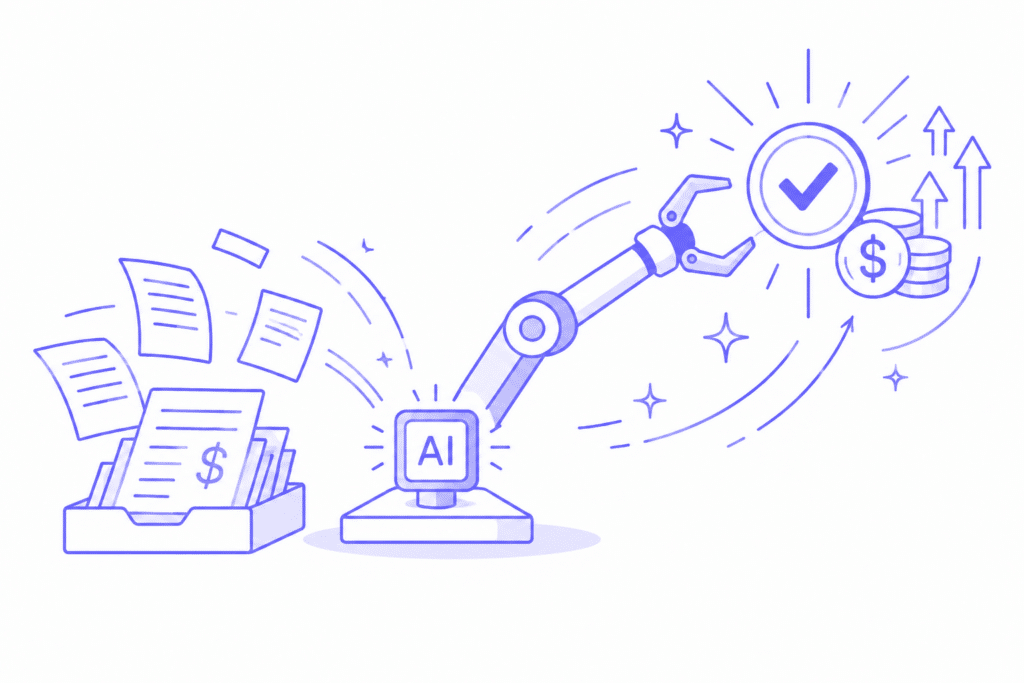
Your AI finance transformation reached the close before it reached the cash. That isn’t a criticism, and it’s probably the most useful clue you have about what to do next.
Think about how the last year actually went. Your close runs shorter than it did, your forecast takes an afternoon instead of a week, and reporting arrives as a draft you edit rather than a document you build from nothing. Then look at receivables, where your largest customer still pays on day 61, and nobody can tell you exactly why.
Both of those are true at the same time, and the reason has very little to do with finance being slow.
What does the AI transformation look like outside finance?
It helps to look sideways for a minute, because finance wasn’t the only function going through this.
A support team’s assistant reads three years of the company’s own tickets before drafting a reply, and when the reply is wrong, the sender fixes it that morning, back in the same system. An engineer’s assistant works against the company’s codebase, so the test suite says within minutes whether the suggestion was any good. Recruiting screens against a job description the company wrote, and legal runs a first pass on contracts using its own playbook.
Notice what none of those involve. Nobody outside the company gets a vote, and that turns out to matter more than which function we’re talking about.
Where has the AI finance transformation actually landed?
Planning and forecasting went first, which makes sense given the conditions. A forecast meets an actual within a month, the financial data already sits in one warehouse, and predictive analytics has a solid foundation to stand on.
Closing the books followed, because those rules live in your own policy documents, and the same fifteen exceptions come back every period. Reporting came after that, then document handling on the payables side, where AI-driven capture and coding delivered real cost savings per invoice, helped along by the fact that a mis-coded invoice turns up in a variance report before anyone goes looking for it. Internal audit and risk management are working through the sampling now, the part that used to fill a junior’s week.
The survey data backs this up. Protiviti’s 2026 Global Finance Trends Survey found that 77% of finance organizations now employ AI, with adoption of financial forecasting climbing from 58% to 76% in a single year. The Hackett Group’s 2026 Finance Key Issues Study has AI implementation as the fourth-ranked finance priority, up from sixteenth the year before, and found 33% of organizations already scaling AI in payables, against 19% scaling it in planning and forecasting.
Consero’s 2026 CFO Survey, based on responses from 102 finance leaders, puts the share at 42% for broad or fully embedded AI in finance, roughly double the 22% a year earlier. The use case they named as the fastest-paying was management reporting and variance analysis, at 53%, with payback inside three to six months.
Line them all up, and they share one thing: each sits inside a system the company administers.
Why did the AI finance transformation cluster in one kind of work?
Your general ledger, your ERP, your planning model, your ticketing system. When a rule changes within any of those, someone on your payroll made the change, which means your automation knew about it before it ran.
Definition
Administered work
Work that happens inside systems your company controls, where you set the rules and you know the moment they change. AI has done its strongest work there and its weakest work everywhere else, which makes that line a better predictor of your next win than any function-by-function survey.
Step outside the line, and configured automation starts guessing, because it’s replaying a path that somebody recorded once. It keeps running even after the path changes, and it reports success even when it’s failing.
What work has the transformation not reached in finance?
Follow an invoice out of your ERP, and you cross that line in a single step.
A state revises a sales tax rule halfway through the quarter. A bank retires the remittance file format your treasury team spent weeks building against. A customer routes your invoice into one of the customer AP portals you’re required to use, then adds a required cost center field to the form, and the person who added it had no particular reason to tell you about it.
Receivables meets more environments your company can’t administer than any other part of finance operations, which is why so much of it still runs on people who remember things, and why AI in accounts receivable trails planning by years.
Then the cost gets misfiled, and this is the part worth sitting with. Cash arrives late, someone logs it as a slow customer, and a slow customer sounds like a relationship problem rather than a process one. Sometimes the customer is genuinely slow. More often, the invoice failed a validation rule nobody knew had changed, so it’s sitting in a state that’s neither rejected nor approved, and no notification arrived because someone set the notification address during onboarding two years ago.
What that costs you depends on where you sit. An accounts receivable (AR) manager works a list of follow-ups on invoices nobody can pay yet. A controller watches revenue and cash refuse to reconcile at the month-end. And a CFO reports days sales outstanding (DSO) that reads as customer behavior on a board slide, when a form is created to represent a real share of those days.
What separates automation that holds up from automation that breaks?
It comes down to one capability, and it’s worth being precise about it. Can the system read the current state of an environment it can’t administer, or does it only replay what somebody configured last year?
A self-learning AI agent reads what the system is asking for today, meets that requirement, and then reports back on what actually happened to the invoice. That’s the practical argument for AI agents in finance, and it’s different from configured automation, which can’t distinguish a changed rule from a failed request and so treats both as noise.
Key takeaway
There’s one question worth asking any vendor who uses the word autonomous: when something outside our control changes, does your automation fail, alert, or adapt? A failure means you bought a script, an alert means you bought a script with monitoring, and adaptation means you bought an AI agent.
The difference only shows up when something moves. A configured workflow keeps submitting to the form it was built for, long after that form has changed. AI agents check what the form is asking for on this submission, so a new required field becomes a field it fills rather than a rejection you read about two weeks later.
Four questions to ask about your AI roadmap
1. Which items sit in administered work, and which cross into systems we can’t control?
Put your finance transformation strategy into two columns and see how they fall. An empty second column means the roadmap is unfinished rather than wrong, and it’s a question about your operating model rather than about software.
2. Which requirements live only in someone’s memory?
Tribal knowledge marks the exact spot where a process left your systems, so look at the spreadsheet tabs, the shared inboxes, and the person everyone asks when an invoice comes back.
3. How do we learn that something external changed?
If the honest answer is that a failure tells you, then you’re funding that delay every month, and it never appears in any adoption metric you report upward.
4. What would we measure to prove it?
In receivables, measure the days between the invoice date in your ERP and the date your customer’s system accepted it, which is where order to cash automation either earns its budget or doesn’t. Most finance professionals have never run that number, and DSO averages it out of view.
How Monto closes the invoice to the payment gap
Monto is the autonomous co-worker that gets you paid by your enterprise customers, end-to-end. It puts self-learning AI agents on every customer relationship, and each agent learns the exact workflows of the AP portals your customers use, Coupa, Ariba, Tungsten, Tipalti, and 600+ others, then carries every invoice from your ERP all the way through to payment.
What that does, in the terms we’ve been using, is put receivables back inside the line. A changed requirement gets met before submission, so a rejection two weeks later never breaks the news to you, and the invoice status you’d have chased by logging in shows up in one place in near real time.
FAQ
What is the AI finance transformation?
It’s the shift from finance teams producing numbers by hand to finance teams reviewing numbers generated by their systems. In practice, that has meant shorter planning cycles and a faster close, reporting that arrives as a draft, and document handling that no longer requires someone to read every page.
Which parts of finance has AI actually changed?
Planning and forecasting, closing the books, reporting, and document handling on the payables side, with the internal audit now in progress. Every one of those sits within systems the company administers, which is what explains the order they moved in.
Why is receivables the slowest part of finance to automate?
Because it depends on systems and rules your company can’t control, from your customers’ payables platforms to tax and banking requirements. AI-powered automation built on a recorded path works until one of those changes occurs, and those changes tend to arrive without notice.
Is this a payables problem or a receivables problem?
Both sides own a piece of it, and the supplier pays for it. Your customer’s payables team gets a system that enforces their requirements, and your AR team gets the job of meeting every customer’s version of those requirements.
Does autonomous mean nobody touches it?
No, it means nobody repeats themselves. Exceptions, disputes, and customer relationships still need people, and any vendor promising zero human involvement is overclaiming.
Where does the AI transformation in finance go next?
Into the work that crosses outside your own systems, because most of the administered work is done. For many finance leaders, that means receivables first, since it holds the most cash and the least control, and it’s the step that lets finance act as a business partner rather than a reporter of delays.
Where this leaves your roadmap
None of this means the AI finance transformation is stalling. It’s just run out of administered work to do, which is a good problem and a solvable one.
So split your roadmap into administered work and everything else, then look down the second column and ask how you currently learn that something has changed. If the answer is the aging report, you’ve found your next project, and it’s probably larger than the one you had planned for next quarter.
Book a walkthrough and we’ll map the part of your receivables cycle that sits in systems you can’t administer.
Book a walkthrough →