
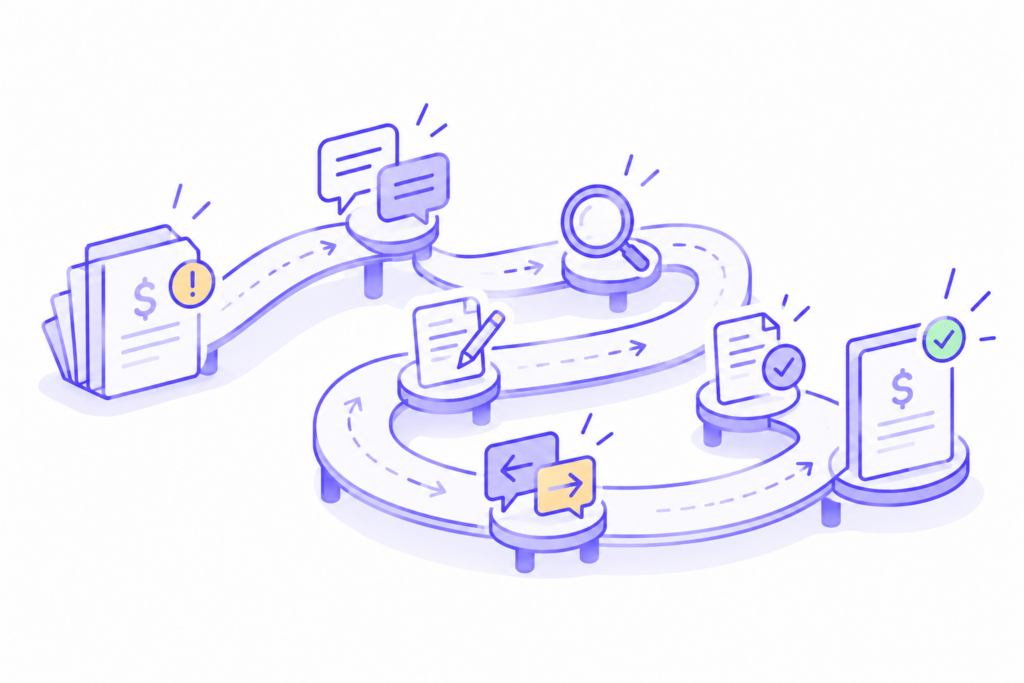
Dispute management turns a customer’s “we’re not paying this yet” back into cash. Your team logs the dispute the day it’s raised, assigns a single owner, settles it with evidence, and closes it for both sides.
The trouble starts when no one knows the dispute exists until the invoice is 45 days past due.
If you run collections, you know the pattern. One supplier’s portal specialist described it on a sales call last month. Some portals email her when they reject an invoice; others don’t, so she has to dig every time.
“And then I’ll pull that invoice and find out how come, and I’ll find out that it was a pricing issue.”
One corrected invoice fixes a pricing issue. Found three weeks late, it costs three weeks of cash flow.
Below: the invoice dispute process step by step, a table of reasons and owners, and how to stop repeat disputes.
What dispute management means for an AR team
Definition
Invoice dispute
A customer’s formal objection to all or part of an invoice. The customer withholds the disputed amount until the supplier corrects it, proves it, or credits it. Dispute management is the process by which the supplier’s AR team captures, routes, resolves, and prevents these objections.
People use “dispute” for three different things, and each needs a different first move:
- Dispute: the customer tells you, before paying, that something on the invoice is wrong.
- Rejection: the customer’s AP portal rejects the invoice, usually due to a missing PO or a format rule violation. The invoice never reaches their payment queue.
- Short payment or deduction: the customer pays less and explains why on the remittance, if at all.
A dispute or a rejection holds up the whole invoice. A short payment shows up in Cash Application, and our guide to reducing short payments covers it. This article covers disputes and rejections wherever one arises.
Why a disputed invoice sits longer than it should
Atradius’s 2026 survey of US B2B payment practices names goods or services not delivered as promised, and slow internal approvals, among the common reasons B2B customers pay late. On your side, each becomes an invoice dispute.
Dispute resolution itself is rarely the slow part. Most of the delay comes before anyone starts, for three reasons.
The dispute lands where your team isn’t looking. A customer flags a price in their AP portal, or an approver sends the invoice back with a comment. Your ERP system still shows the invoice as open and current. So the first person on your side to hear about it is a collector making a past-due call.
Nobody owns it. Sales has to confirm the contract rate, billing has to reissue, and collections has to chase the corrected invoice. Without one named owner, each team assumes another has it.
The evidence is scattered. A deductions analyst at a building technology manufacturer explained what a customer claim needs: “We need the backup documentation.”
The proof often sits in a third system, behind a login. Someone has to go and get it.
At Imagine, every biller checked their own portals for rejections and tracked them in a shared spreadsheet.
Customer Quote
“It was just a lot of involvement in that, using an Excel spreadsheet and following up on that.”
— Yenny Garcia, Manager, Billing, Imagine
So the first job is knowing a dispute exists, and sorting which invoices can be paid now from the blocked ones.
The invoice dispute process, step by step
1. Log it the day it’s raised
Create a record the day the dispute shows up: an email, a call, a portal comment, or a Rejected status. Note the invoice numbers and PO number, the dispute amount, and the reason in the customer’s own words. Add the date raised and the owner. Keep one record per disputed line, however many calls it takes.
2. Get the undisputed amount paid
A $2,000 price difference shouldn’t hold up the other $38,000 of a $40,000 invoice. Ask the customer to approve and pay the undisputed lines now, as a partial payment.
Some portals accept partial approval, so one request is enough. If the portal doesn’t, credit the invoice in full and reissue it as two invoices: one for the agreed amount and one for the disputed amount.
3. Name the reason and route it to one owner
Use a short, fixed list of reasons for disputes; the table below is a good start. Route each reason to the team that can fix it. Collections keeps the case and the clock, and the owner fixes the cause.
4. Collect the supporting documents
One document settles most disputes: the signed contract or price list, the PO and its revisions, the proof of delivery, the timesheet, or the receiving record. Pull it before you call the customer back, so that one call settles the dispute.
5. Resolve it in writing
There are three outcomes:
- The customer is right: you issue a credit memo or start correcting the invoice.
- You’re right: you send the evidence and ask for approval.
- Both are partly right: you credit the agreed-upon portion and rebill the remainder.
If the customer uses an AP portal, you resubmit the corrected invoice there, against the right PO. Many customers restart the payment terms from the new acceptance date. Get the PO right the first time, because PO mismatches are a common reason corrected invoices bounce again.
6. Close it on both sides
A dispute closes when the customer’s system shows the invoice as approved. Check the status in the portal and note the expected payment date. Then close the record with the root cause filled in, for the monthly review.
Dispute reasons, owners and fixes
| Dispute reason | Who fixes it | Evidence that settles it | Resolution | How to stop repeats |
|---|---|---|---|---|
| Price doesn’t match the contract or PO | Sales or account management, then billing | Signed contract, current price list, PO line price | Credit and rebill at the agreed price, or send the contract | Sync price changes to the ERP before the next billing run |
| Quantity billed differs from quantity received | Operations or warehouse | Proof of delivery, packing list, the customer’s receiving record | Credit the difference, or send the signed delivery proof | Bill from shipped quantities |
| Goods damaged, not delivered or service not performed | Operations or service delivery | Delivery signature, photos, completed work order or timesheet | Replace, re-perform, or credit | Attach proof of delivery or service to the invoice at submission |
| PO missing, wrong or out of funds | Billing, with the customer’s requester | The PO and its revision history | Get a corrected or topped-up PO, then resubmit | Check PO number and remaining balance before submitting |
| Duplicate invoice | Billing | Invoice history in the ERP and in the customer’s portal | Cancel the duplicate with a credit memo | Never resend a portal invoice by email “just in case” |
| Freight, tax or surcharge not agreed | Sales, then billing | Contract terms, quote, shipping terms | Credit the line, or send the clause that allows it | Put every surcharge in the quote the customer signs |
| Backup documents missing | Billing | The required document: proof of delivery, bill of lading, lien waiver, timesheet | Upload the document and ask for re-review | Keep each customer’s document rules on file and submit the full packet the first time |
| Wrong legal entity, address or cost center | Billing, with the customer’s AP team | Customer master data, the vendor record in their portal | Reissue with the right details | Confirm the customer’s billing details whenever a PO comes from a new entity or site |
Why It Matters
The reason code decides the owner, and the owner decides how long the dispute takes. Send a pricing dispute to billing, and it waits while billing asks sales. Send it to sales on day one, and one conversation can fix it.
Who owns what in invoice dispute management
- Collections owns the case from logging to approval: the record, the deadline, and every follow-up with the customer.
- Billing owns anything you reissue, credit, or resubmit.
- Sales or account management owns pricing and contract questions, because only they know what was agreed.
- Operations owns proof that the goods or services arrived.
Set two targets you can measure. Log and route every dispute within one business day. Have every owner report a resolution or a blocker within five. Review the open list weekly, oldest first.
For credit managers, dispute history is a credit signal. Mostly valid disputes tell you something about your own billing.
A customer who disputes every invoice over a threshold, or clusters disputes at quarter-end, is managing their cash with your receivables. Add that to their next credit review, next to days past due.
How to stop the same disputes from coming back
Once a month, count resolved disputes by reason and by customer. Two or three reasons usually cause most of them. Each traces back to a step before the invoice went out: a stale price list, an unchecked PO, a missing delivery proof.
Fix the step, not the dispute. Run validation checks before submission: PO number, PO balance, contract price, and required documents. They stop the most common disputes and rejections before the customer sees the invoice.
Submit the full packet the first time. Then check the status of every invoice in the customer’s portal at least once a week. These manual processes take time, but they bring you the disputes you can’t prevent within days. Our piece on why “sent” doesn’t mean “accepted” covers which statuses to watch.
Key Takeaway
You win dispute management before the dispute starts and in the first day after it does. Prevent repeat reasons with checks before submission. For the rest, log, split, and route each dispute to a single owner on the day the customer raises it.
How Monto helps you see disputes sooner
Monto is your team’s AI co-worker for invoice-to-cash. It takes on the repetitive invoice processing your billers do for each customer today. It submits every invoice as the customer requires, with the supporting documents they request, and follows through on payment. That covers Coupa, Ariba, Tungsten, Tipalti, and the remaining 600+ customer AP portals Monto supports.
When a customer rejects an invoice or sends it back, Monto brings your team the status and the customer’s reason that day. Your dispute record starts then, not at the next past-due call. Remittance details come back to the same place, so a short payment shows the variance and the customer’s reason.
Monto doesn’t decide the dispute for you. Your team still decides what was agreed and what to credit. What changes is when you find out, and how much evidence is already in front of you. Matching remittance to open invoices comes next, and our walkthrough of cash application picks it up from there.
A dispute is a question with a deadline
Every disputed invoice is a question: is this the price we agreed on, did this arrive, where’s the document? Answer within days, and the payment can still land this month. Leave it, and it becomes an aged receivable, then a write-off nobody decided to make.
Find out the day a customer rejects or disputes an invoice in their AP portal, with the reason attached.
Talk to our team about your invoice disputes →FAQ
What is dispute management in accounts receivable?
Dispute management is the process by which an AR team handles customer objections to invoices. The team logs each dispute when it’s raised, routes it to the person who can fix the cause, and settles it with evidence, a credit memo, or a corrected invoice. It also tracks the reasons, so the same disputes don’t keep coming back.
What is the difference between an invoice dispute and a short payment?
A customer raises an invoice dispute before paying and withholds the disputed amount or the entire invoice amount. A short payment occurs when the customer pays less and may explain it on the remittance. Collections and billing work disputes; cash application handles short payments.
Do I have to pay a disputed invoice?
A customer can withhold the disputed amount while both sides resolve the dispute. The undisputed part is still due on the original payment terms. Suppliers should request that the undisputed lines be approved and paid now. If the portal can’t approve part of an invoice, the supplier credits it and reissues it as two invoices.
How long should it take to resolve an invoice dispute?
Log and route it within one business day. Get a resolution or a named blocker from the owner within five. Close it once the customer’s system shows the invoice approved. Pricing and documentation disputes settle fastest when you pull the evidence before calling the customer back.
Can validation checks reduce invoice disputes?
Yes. Check the PO number, the remaining PO balance, the contract price, and the required documents before you submit an invoice. These checks prevent the most common disputes and portal rejections. Track your top dispute reasons monthly and add a check for each one.
How do I find out that a customer disputed an invoice in their AP portal?
The customer’s AP portal records the dispute or rejection, with whatever message it shows, and not every portal emails you. Check the status of every open invoice in each portal at least weekly, or use a tool that reads those statuses for you. Then disputes reach your team the day customers raise them.