
How much can AI invoice automation actually reduce portal rejections?
By a meaningful margin, automation handles each portal’s specific requirements rather than treating all portals the same. Cloudinary, submitting across 41 different customer AP portals, cut invoice rejections by 23.5% after automating submissions with Monto, with each portal’s formatting and field requirements handled automatically instead of being re-keyed by hand.
Does automating invoice submission actually improve approval rates?
Yes, and the effect grows with portal count. AppsFlyer, submitting across 48 unique customer AP portals, reached a 97% invoice approval rate after automating with Monto, up from a manual process that led to frequent errors and rejections across that many portal configurations.
How does Monto handle purchase order number matching?
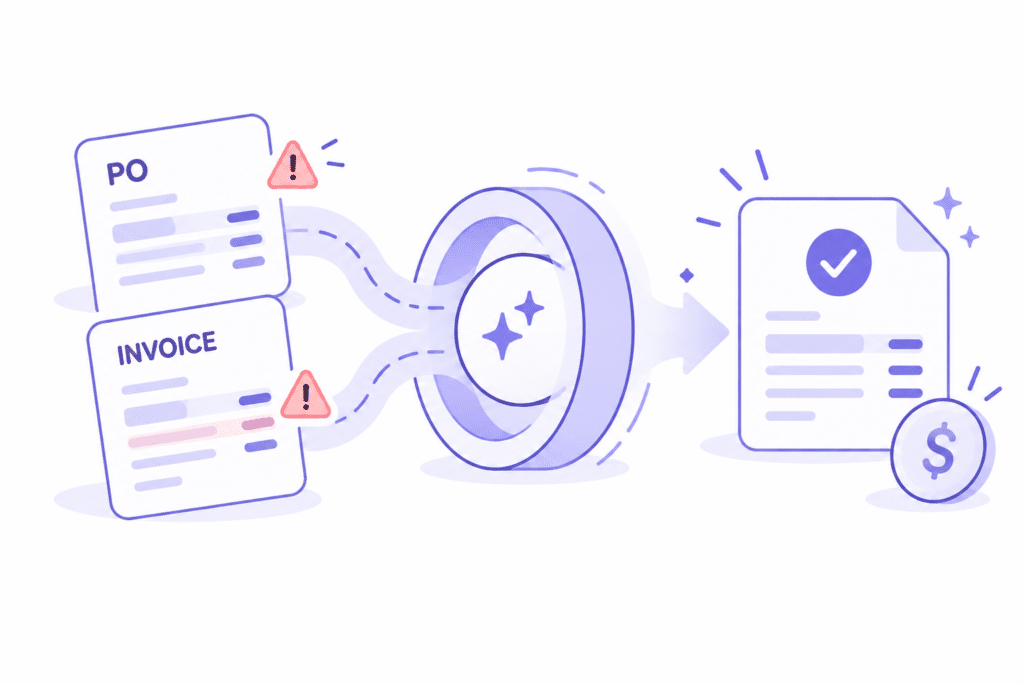
The PO reference on an invoice often doesn’t match how the customer set it up on their end. That’s a data discrepancy you have to resolve before you submit anything. Monto reconciles invoice data and line items against PO data and line items. It catches and fixes mismatches before they reach the portal.
G2 reviewers call out PO and invoice tracking as a core strength. As Nagaraj Basawaraj, Sr. Billing Specialist at Planview, puts it: “all your POs and invoices in one place, tracking made simple.” (G2 review)
Why do PO prefixes or formatting quirks cause invoice rejections?
Different customers format the same information differently: PO prefixes, required reference numbers, and specific field orders. A portal will reject an invoice that doesn’t match its exact expectation, even when the underlying numbers are correct. And not every mismatch starts at the portal. A single PO often passes through sales, billing, and collections before it lands on an invoice, and when those teams are working from different versions of the same detail, the reference that reaches the portal can be off before formatting ever comes into play. Keeping that information aligned internally is half the job.
That’s also the kind of per-customer rule Monto’s AI agents learn and apply. Monto reconciles the invoice to the PO before submission, catching internal errors in the same pass. That’s why rejection rates drop once the system takes over from someone checking each invoice by hand.
Can automating PO and invoice matching free up my billing team’s time?
Substantially, and teams feel it fast. Most of the time, the cost in PO and invoice matching is repetitive re-entry per portal, not the matching logic itself, and that’s what automation removes. TechTarget put it plainly through Mike Reardon, Director of Revenue Operations: “Monto is a game changer! The amount of time Monto has saved our collection team far exceeded our expectations.” With submission and matching handled automatically across every portal, the hours that used to go into keying the same invoice into one portal after another go back to the team.
Does better PO and invoice matching actually shorten DSO?
Yes, directly. A rejected or mismatched invoice doesn’t start its payment clock until the customer accepts the resubmission. Cleaner matching results in invoices being paid sooner, which shortens Days Sales Outstanding (DSO). ES&E felt this before Monto. Its customers don’t start the payment term until the invoice is correct in their portal. If you catch a problem late, the whole clock resets. “It basically doubles your receivable time, or DSO, for those customers that have extended terms,” says Mark Sellers, ES&E’s Sales Manager. After automating with Monto, ES&E cut its rejection rate from 2.2% to 1.1%. Past-due invoices on one account fell from 50 to 3. Matching accuracy and payment speed move together, because every clean submission is one less invoice waiting on a fix.