
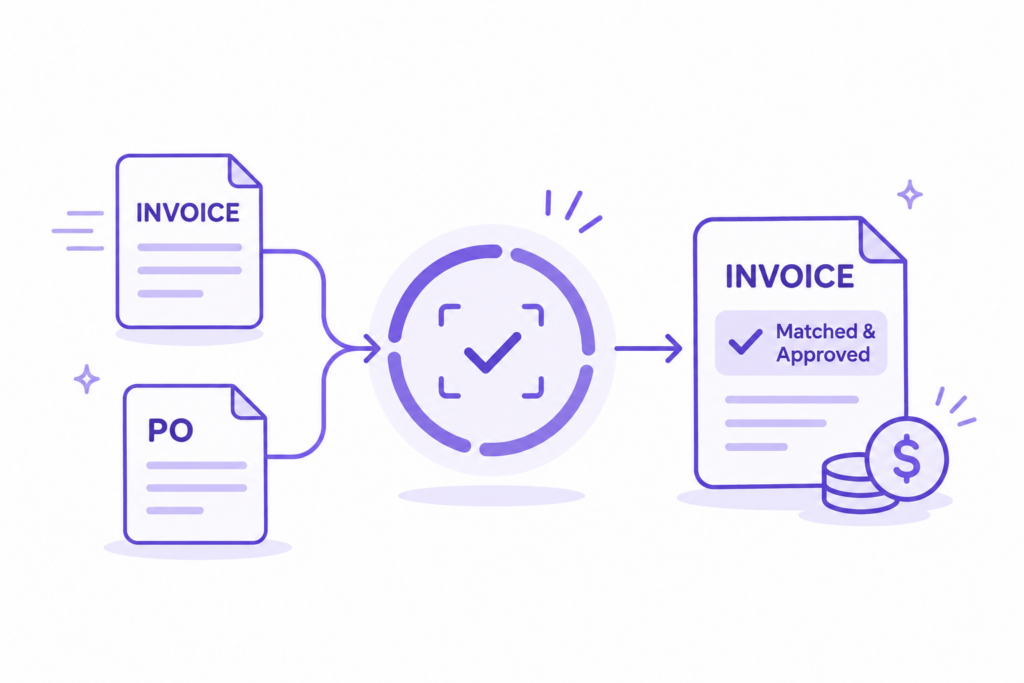
Invoice hell is real
You send the invoice. Then nothing happens. The PO was missing. Or wrong. Or the invoice is stuck in an approver’s inbox. Without supplier invoice automation, nobody tells you.
Three weeks later, your collector calls about a late payment. That’s when you find out the invoice never matched. Now your team is deep in a Slack rabbit hole, chasing a PO number, while your customer gets cranky and your cash flow forecast is toast.
Sounds familiar? For most billing teams, this plays out dozens of times a month. On your side, invoice matching has become a strange mix of detective work, digital archaeology, and corporate diplomacy. Finance professionals with advanced degrees spend their days hunting PO numbers, checking line items, and pleading with busy buyers for approvals.
It shouldn’t be this hard. Your customer’s AP team decides whether your invoice matches. But almost everything that makes it match or fail happens before you hit submit. That’s where supplier invoice automation starts. It’s how billing teams can finally kill the match-and-chase routine for good. Let’s explore how.
1. Manual matching fixes are holding billing teams back
Think about how much of your team’s week goes into invoices that didn’t match. People who should be working on collections or cash forecasts spend their days reissuing invoices, correcting PO numbers, and resubmitting to portals.
Look at how supplier invoicing works at most companies today. Invoices leave the ERP as PDFs. Someone uploads them to dozens of customer portals, each with its own login. A shared spreadsheet tracks what was sent, and chat threads handle the exceptions.
At Demandbase, the billing team had more than 30 portals and spent around 15 to 20 hours a week on uploads and status checks. That patchwork barely holds up in a normal month. At quarter-end, it breaks.
The cost goes well beyond the hours:
- Cash arrives late. Your payment terms usually start when the customer approves the invoice, not when you send it. Every week an invoice spends unmatched is a week added to your DSO.
- Customers get frustrated. Their AP team keeps rejecting the same kinds of errors, and your account managers hear about it.
- Teams start blaming each other. Billing asks sales for the right PO. Sales asks the customer. Simple questions turn into week-long investigations.
- Perhaps worst of all, forecasts turn into guesswork. If you can’t tell which invoices will match on the first try, you can’t tell when the cash will land.
The problem isn’t effort. It’s how your invoices reach your customers in the first place.
2. The real problem: chaos at the source
To see why matching fails, look at the moment your invoice leaves your hands. The matching problem doesn’t start in your customer’s AP system. It starts with what you send.
Every customer wants something different. One takes email. Another requires its Coupa or Ariba portal. A third has a portal it built itself. Each one expects different fields, attachments, and PO formats.
Customers’ rules also change without warning. A new required field, a new cost center, a stricter PO match. The invoice that went through last month gets rejected this month.
Without one standard way to submit, there’s no single source of truth. The same invoice can sit in your ERP as “sent”, in the portal as “rejected”, and in your collector’s notes as “chasing”.
By the time your customer tries to match it, the invoice has already picked up the problems that make it fail. That’s why zero-touch matching begins upstream, with what you send and how you send it.
3. Supplier invoice automation: getting it right the first time
What does it look like in practice? The best billing teams have moved from fixing rejections after the fact to preventing them before submission.
Every invoice gets checked against what that customer requires before it goes out. Is the PO number right? Does the PO still have enough funds? Are all required fields filled, and are all documents the customer requests attached?
Clean invoices go straight to the customer’s portal. Only real exceptions reach a person, with the reason attached, like “PO only has $10,000 left; invoice is for $60,000.”
After submission, someone keeps watching. If the customer’s AP team rejects the invoice or sends it back, you know the same day, not at the next past-due call. Our guide to PO mismatches and invoice rejections covers the most common reasons in detail.
The result? No more missing documents, no more lengthy email threads, and no more urgent “Can someone fix this PO today??” messages as quarter-end creeps up.
4. Why vendor invoice submission tools are the real MVP
Zero-touch matching only works if you control how your invoices reach each customer. Without clean data at the source, even the best AP matching system on the customer’s side will reject them.
Customer AP portals are now standard for enterprise buyers, and each one adds its own logins, formats, and rules. Doing that by hand across dozens of portals makes consistent invoicing nearly impossible.
Monto is your team’s AI co-worker for this work. It learns what each customer requires, delivers every invoice the way the customer expects, and tracks it through to payment. Your team works from one dashboard instead of dozens of logins.
Customer Quote
“Monto reduces a lot of manual intervention across the portals. It identifies exceptions such as missing POs. We have all of that on a single dashboard.”
— Srikanth Kota, Billing Manager, Demandbase
When every invoice includes the correct PO, line items, and supporting documents from the start, matching becomes a formality, not a fire drill. Demandbase now gets paid a week sooner.
5. What’s next: the zero-touch future
As supplier invoice automation matures and invoice matching automation spreads on the buyer’s side, a few capabilities are changing how billing teams work:
- Smarter exception handling. AI sorts exceptions by value, urgency, and customer history, so your team works on what matters most first.
- Visibility beyond finance. Sales and customer success see payment issues on their accounts as they happen, before they turn into awkward renewal conversations.
- Live views for leaders. Finance leaders can see which invoices are approved, blocked, or paid in real time, rather than waiting for a weekly report.
- Clean data end to end. When the data stays clean from your ERP to the customer’s portal to payment, forecasting and analysis get easier.
This isn’t just about matching. It’s about momentum
Invoice matching may seem like a narrow technical problem, but it touches your whole business. Cash flow is the heartbeat of your company, and unmatched invoices are blockages in its circulatory system.
The future isn’t better manual fixes. It’s flow: clean invoices, submitted right the first time, tracked until they’re paid. When that works, matching disappears from your team’s day, allowing them to focus on collections and planning.
Monto helps you escape invoice hell for good, one customer portal at a time. Zero-touch matching isn’t a far-off goal. For billing teams with enterprise customers, it’s quickly becoming the baseline. The only question is how quickly your team will get there.
See how Monto gets your invoices matched and paid without the chase.
Talk to our team about your customer portals →FAQ
What is supplier invoice automation?
Supplier invoice automation is software that handles a supplier’s invoices from the ERP to payment. It checks each invoice against the customer’s requirements, submits it through the right channel or portal, and tracks it until the customer pays.
Why do supplier invoices fail to match?
Most supplier invoices fail to match because of problems at the source: a wrong or missing PO number, a PO with insufficient funds, a required field or attachment missing, or a format the customer’s portal doesn’t accept.
What is zero-touch invoice matching?
Zero-touch invoice matching means your invoices match the customer’s PO and receipt records without anyone having to fix them by hand. It depends on sending clean, complete invoices the first time.
How do vendor invoice submission tools help suppliers get paid faster?
They submit each invoice as each customer requires and flag any problems before submission. They also show you rejections the same day, so invoices reach approval sooner, and payment terms start earlier.